
Funkysteps: an online footwear store
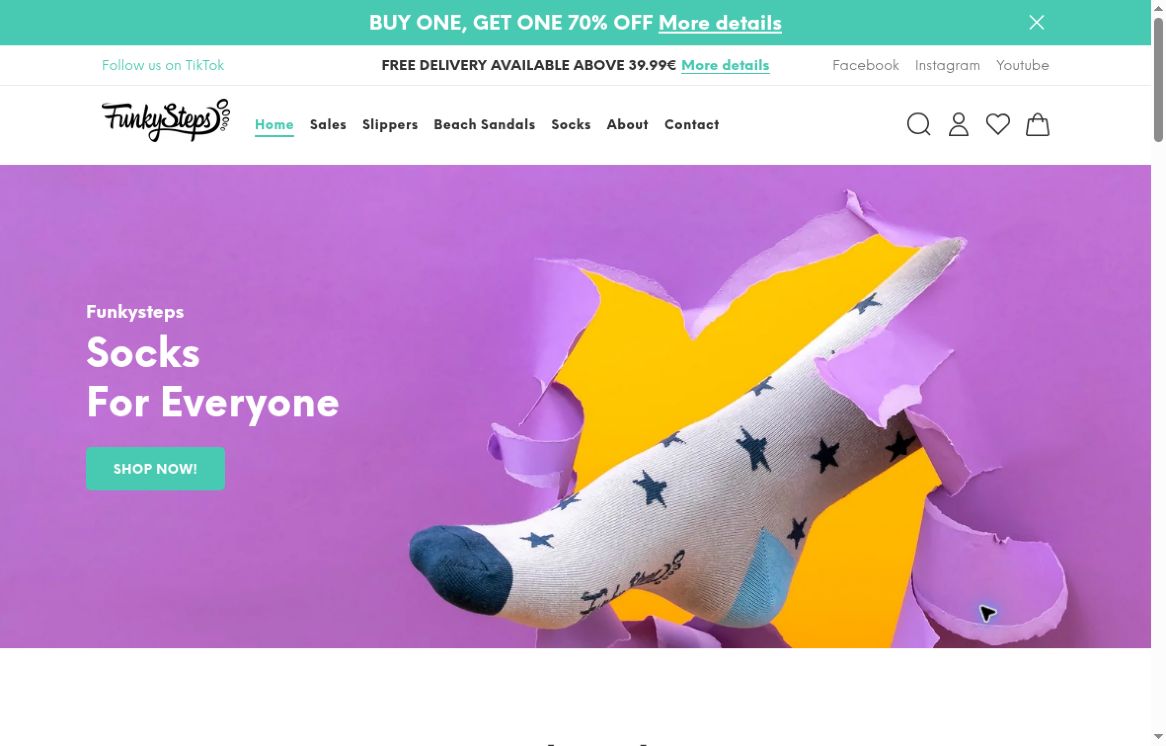
Funkysteps created an online store for slippers, socks, and footwear. The project aimed to provide the brand with its own e-commerce space, where its collections would be presented alongside the unique character of Funkysteps.
Project brief
Create an online store for everyday products where practicality meets distinctive style.
Our work
- Online store creation.
Result
The Funkysteps online store has been implemented to showcase the brand's collections and facilitate online sales.
Everyday footwear as a branded collection
Slippers and socks are practical purchases, but style is part of the Funkysteps offer. The brief was to give the collections a retail space where the products and the brand’s character could be seen together. Visitors can explore a collection before choosing a piece for everyday wear.
Our online store development process
How do socks and slippers differ as purchases?
Funkysteps customers can look for slippers, summer sandals or a particular kind of sock. Ankle, regular and no-show socks meet different everyday needs. Buyers often know when they will wear something before deciding on a colour or a particular design.
How do collections complement everyday shopping?
The shop also presents gifts, new collections and bestsellers. That is another entry point for a visitor who did not arrive looking for a specific pair of socks. The Funkysteps footwear store gives the brand a space for both kinds of shopping: choosing a practical item and getting to know the wider collection.
Socks and slippers raise different sizing questions
Socks often fit a range of sizes. A closed slipper can depend more on the shape of the model. A shopper may know their usual shoe size and still want to check this particular pair. Gift buyers cannot try the item themselves. Sizing information is most helpful beside the actual variant choice.
Colours and patterns encourage browsing, but a purchase may hinge on one condition: is the right size available? Try selecting two pairs, one for yourself and one as a gift. Their sizes, patterns and quantities should be easy to distinguish in the basket. A single product photograph cannot test that.
When is a collection view enough?
Someone browsing for ideas wants to see several patterns at once. Once a pair catches their eye, they zoom in and check the shape and size. Collection photographs must work on a small screen. Supporting views can then show details such as a slipper sole or the texture of a sock.
Checking the image against the product name
Take two pieces with similar patterns but different shapes. Show them in a collection and then individually. If the pattern is recognisable but the product type is unclear, revisit the card. Then choose a size, add one pair and return for another. A basket containing both pairs reveals how reliably the buyer can distinguish a gift from their own purchase.
Check the size label on the product card against the wording in the basket.
Related project
MM Stitch adds a personal choice to size and colour: the buyer’s wording must stay with the correct garment. Everyday footwear has a simpler set of options, but the two-pair test reveals a shared principle. Someone should be able to read the basket and describe exactly what will arrive. This makes a useful check before introducing a new collection, particularly on a phone where similar patterns can be hard to distinguish.